

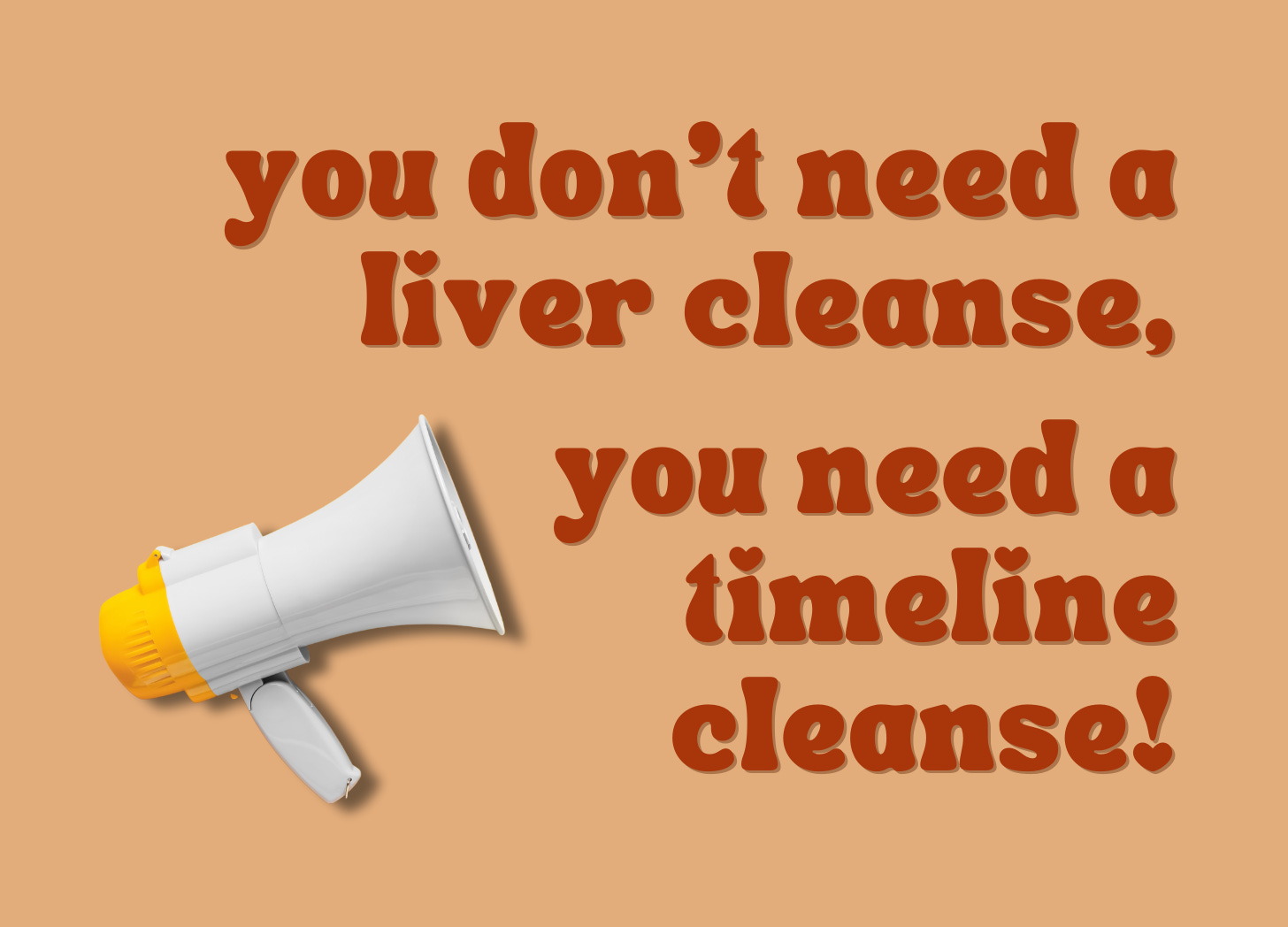
You Don't Need A Liver Cleanse, You Need A Timeline Cleanse
We need to be more discerning with our views and clicks in 2025
It’s that time of year. My social feeds are filled with ‘wellness’ content, which is typically scaremongering, fatphobic, or filled with baseless claims about health, designed to make me feel bad about myself and ultimately part with lots of money to ‘fix’ whatever issue they’re telling me to be self-conscious about.
For those of us with chronic skin conditions, the tactics are all too familiar.
Every week I scroll through my timelines and see people with little or no medical knowledge instructing people they’ve never spoken to how to ‘cure’ their incurable conditions.
‘You just have to heal your gut!’
‘Doctors don’t want you to get better, Big Pharma can’t be trusted!’
‘I cured my rosacea with this one product (link in bio)!’
‘You just need to cleanse your liver!
Please imagine me gently holding your lovely, trusting, overwhelmed face in my hands as I say this to you: You do not need a liver cleanse, you need a timeline cleanse.
I have spoken many times before about the pros and cons of social media. It has helped me enormously with my rosacea in so many ways. It gave me access to a community of hundreds of thousands of other sufferers, who have given me support, empathy, and understanding. It gave me access to information that I wasn’t able to get elsewhere. It brought me a job educating and supporting the people who need it. But social media is also a dark place, filled with people who will happily take advantage of you to line their pockets.
As the internet grows and our attention spans wither, clickbait has become an unavoidable part of ‘informative’ content online. We’ve all seen the video thumbnails: ‘doctors can’t believe these results!’ ‘I cured my rosacea with this one product!’ ‘you’re doing skincare wrong!’
Content is rewarded for being short, which takes away nuance and in-depth explanations. It is rewarded for being controversial, so anything rage-inducing, sad, or promoting incorrect information will get lots of reactions and comments, which means it is then shown to more people, which gets more comments…
Common forms of misinformation I see in the skincare community:
People online are competing for your attention and they will do anything to get it. This is how misinformation breeds and spreads.
There are a few different kinds of misinformation, some of which are more insidious than others, but it all leads towards and contributes to the same harm. Here are the most common ones I see in the skincare world:
Doctors who have relevant training but who haven’t stayed up to date.
Example: “it’s unlikely to be rosacea because you’re too young/not white”
Doctors who have training, but in an irrelevant field.
Example: an anaesthesiologist commenting on tapeworms.
Huge platforms led by people with no relevant training, who interview people with irrelevant/outdated/incorrect information who are usually peddling something.
Examples: Huberman, Rogan, Bartlett, insert literally any other podcast dudebro here.
Platforms who present themselves as scientific but have undisclosed monetary interests and rely on cherry-picking data and fearmongering.
Example: EWG, apps like ThinkDirty, Yuka.
Brands who utilise greenwashing and cleanwashing to sell products through fear.
Example: Drunk Elephant with their ‘Suspicious 6’.
MLMs who make wild claims about their products that cannot be backed up with science or proof.
Example: Doterra reps claiming their products can help with the effects of smoke inhalation during the LA wildfires.
Influencers who use their large followings to sell products with no scientific proof, usually paired with fearmongering and guilt.
Example: throw a dart at the internet and you’ll hit 5!
General population who repeat the misinformation above like it’s gospel.
Examples: “I read something…” (by which they mean ‘I watched a 30 second TikTok video’) or “my sister’s hairdresser’s mother-in-law cured her rosacea with lemon juice!”
Rosacea sufferers who think their personal experience overrides common sense, medical knowledge, or basic statistics.
Example: “I reversed my rosacea by washing with just water, you don’t need any of that other stuff.”
Why do we fall for misinformation?
Some of these forms of misinformation are more understandable than others and I do understand why people are susceptible to falling for it and why this kind of content spreads so quickly and easily.
The main reason that I see a lot in the rosacea community is desperation. We are often targeted by unscrupulous grifters because they know we’re vulnerable and desperately want to find something that will help. And if that ‘one simple thing’ is something you can do for yourself, with no medical intervention, that’s cheap and easy… it’s obvious why that would appeal to most people.
There are also two bizarrely opposite issues at play in this space. The first is that the average person is easily swayed by the ‘white coat effect’ or ‘authority bias’: we see a person with the name ‘DrXYZ’, who puts out videos where they’re wearing a white coat, or scrubs, or has a stethoscope around their neck and we automatically have trust and belief in what they’re saying… as long as it confirms our existing biases.
However, on the flip side, if they’re telling us something that’s the opposite of our beliefs or lived experience, then they are immediately labelled as a shill for Big Pharma, or paid off by a brand, or purposefully gatekeeping the real information. So in the same breath, one person can be trustworthy simply because they’re a doctor (or call themselves one) and another doctor can be untrustworthy because they say things we don’t like.
This lack of trust in the medical community can drive people towards those who talk a big game with absolutely no science to back them up. I’ve spoken to countless rosacea sufferers over the years who have never been to doctor about their skin, or people who had one appointment but didn’t go back because ‘the doctor didn’t help’. Believe me, I understand that feeling and I have been there myself many times. It’s natural to try to find the solution that feels right for you.
"You are not to blame if you’ve been fooled by these people, it’s what they are good at and they work hard to pull the wool over your eyes. They are the health equivalent of cult leaders: charismatic, appealing, and offering exactly what you need when you are most vulnerable. It’s only later that you realise that your wellbeing was of no interest to them.”
I was diagnosed 20 years ago, the internet was a very different beast back then. I am sure that if I was diagnosed now, I would very easily be pulled in by the social media grifters that dominate with baseless claims in sexy packaging. You are not to blame if you’ve been fooled by these people, it’s what they are good at and they work hard to pull the wool over your eyes. They are the health equivalent of cult leaders: charismatic, appealing, and offering exactly what you need when you are most vulnerable. It’s only later that you realise that your wellbeing was of no interest to them.
How can we avoid misinformation online?
With this in mind, I wanted to offer you some actually useful, tangible tips on how to navigate this complicated and confusing internet landscape. And - in the spirit of this article, and staying in my lane and deferring to experts! - I asked some of my favourite SciComms creators for their tips and advice:
Ask yourself: Is this person qualified to give this advice?
Just having generic medical training isn’t enough, the person needs to have relevant and up to date training. People with medical knowledge may be better equipped than a layperson to discuss health and wellbeing, but if their knowledge isn’t relevant it’s not adding anything meaningful to the discussion. The fantastic Dr Michelle Wong (cosmetic scientist and author) uses her platform and expertise to correct misinformation, often gently reminding other medical experts to stay in their lane and not using their title to try to influence others with incorrect information. A prime example HERE. She also wrote a great post HERE about misinformation in general.
Ask yourself: does this claim go against scientific consensus?
If you hear a shocking medical claim or a tip that is presented as ‘something no one else wants to tell you’, look at the medical consensus. Is the reason no one else is talking about it because it’s bullshit? For example, if 99.9% of dermatologists are telling you that sunscreen is the best way to protect your skin against skin cancer, but one TikTok chiropractor is telling you that sunning your perineum is healthcare, who should you trust? The latter might talk a big game about Big Pharma not wanting to tell you the truth, that the sun gives us life, that none of our ancestors died of skin cancer etc. But realistically, what is more likely: that this one man is the only truth-teller in the whole field of medicine and health, or that the medical consensus is a consensus for a reason? Claiming you have discovered something no one else knows is a classic (and successful) clickbait trope, but is often devoid of any reliable sources, beyond 'Trust Me Bro’. Thank you to the wonderful Hannah Collingwood English (pharmaceutical scientist and author) for this important tip.
Ask yourself: is this person a trustworthy source?
Matthew Facciani (social scientist specialising in misinformation, media literacy, and AI) introduced me to two new concepts to keep in mind when looking at information online: reading laterally and critical ignoring. If you click on those phrases, I’ve linked some articles that Matthew shared with me which I really recommend you read, but here’s a quick and dirty summary:
Reading laterally means that if you’re trying to identify how trustworthy a source is (whether that’s a person, an account, or a website) you should research what other people say about them. The source itself cannot be trusted to be unbiased. For example, the Daily Mail might themselves say that they’re a popular and long-running newspaper, but when you research further you discover that even Wikipedia won’t allow the Daily Mail as a ‘news’ source because they are so untrustworthy.
Critical ignoring is useful when faced with the sheer amount of information that we’re exposed to on a daily basis. Critical thinking used to be enough - we were taught to look at information with common sense and a bit of distance to try to identify trustworthy content. But that’s no longer enough. For example, we also need to try to weed out content that is purposefully combative (e.g. clickbait) or people arguing in bad faith (e.g. trolls or devil’s advocates). These are distractions that deplete your energy and interest, leaving less time and mental space for worthwhile content.
Ask yourself: is this person an expert or do they just have lots of followers?
I couldn’t reach Dr. Andrea Love (biomedical scientist, immunologist and microbiologist), but I adore her content and so I wanted to share this tip from her instagram account that I think you’ll find helpful:
Popularity ≠ expertise. If you see an account with millions of followers, it automatically and subsconsciously gives their content weight. We assume that that many people can’t be wrong (which is bonkers when you consider the results of many popular decisions in recent years: Brexit, the Tories, Trump… twice), or that if they were spreading incorrect or damaging information they would be called out.
But certain accounts become too big to fail: they can set their flying monkeys on anyone who disagrees and wield their power and money to stamp out anyone who disagrees with them (à la JK Rowling). This results in situations like this one, where popular influencers with no formal qualifications end up advising congress on topics far outside their scope of expertise.
Ask yourself: what will the person gain from sharing this content?
And to sum this up, I wanted to finish on a fantastic quote from Tony from capri.corneum:
“Remember, if something you read sounds scary, pretty often someone wants you to be scared”
I hope you found this post interesting, I’ve been wanting to talk about this topic for a while as it both fascinates and infuriates me. I deleted and rewrote this article about 3 times because I kept going off on tangents and rants about various different aspects of the story: reading comprehension, internet literacy, fear, vulnerability, internet grifters… it’s all intertwined. Hopefully the tips and links I’ve shared above have helped you to feel empowered and prepared to approach health misinformation with more confidence.
All of the experts I asked to contribute are fantastic people to follow and improve my social media feeds no end. If you’re looking for other SciComms accounts to follow, I’d also recommend Jen from The Eco Well and Mohammed from Moskinlab.
FURTHER READING:
If you’re interested in learning more about the ways your social media algorithms are selecting the worst possible things for you to see, this post will be of interest:

If you would like to read my recent rosacea-related posts, you can find them all HERE.
100% to all of this. Even as a very skeptical GenXer it’s easy to want to believe that “xyz” product is the elixir my skin needs when in reality the micellar water I saw recommended on your blog years ago has been a gentle way to calmly clean my skin. I never tire of saying
I will be forever grateful for your perspective, knowledge and recommendations. I appreciate your disclosure that you’re not a trained professional yet your depth of knowledge and ability to teach us how to navigate rosacea wildly surpasses anything I received from the university hospital board certified dermatologist I saw years ago. Time to buy you another coffee!
Just what we need to see to get out from under the mountain of misinformation